
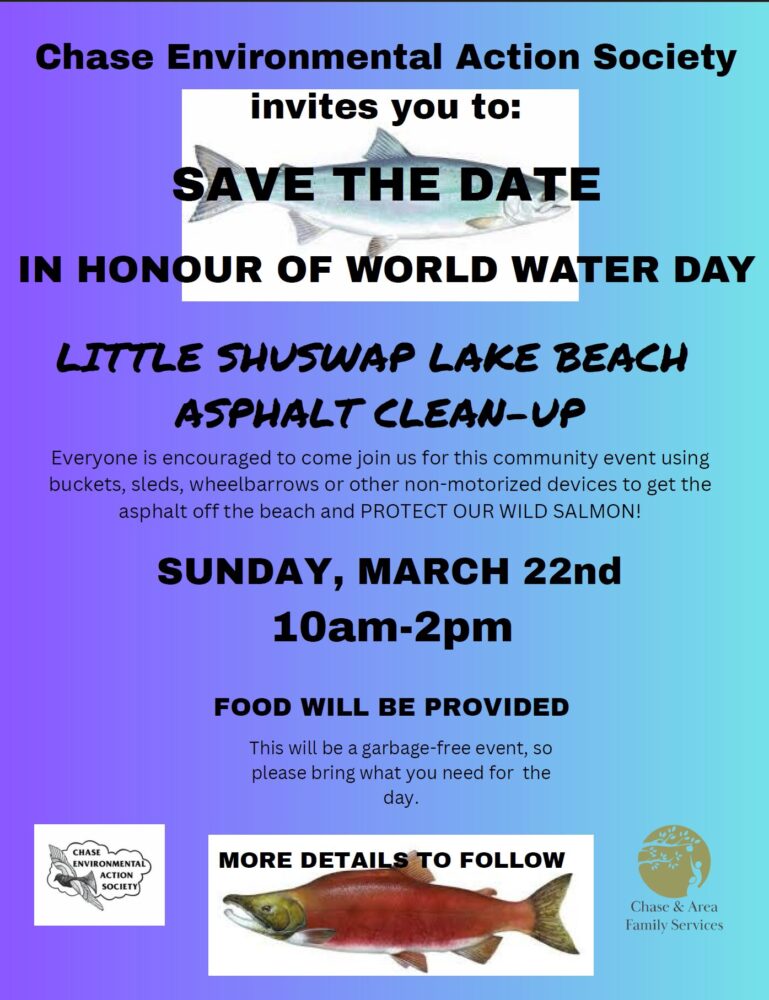
Little Shuswap Asphalt Clean-up
The Chase Environmental Action Society is organizing a Beach Asphalt Clean-Up for World Water Day 2026 – are you in?
Where: Along the beach where the ‘Tire Berm’ is located
Access through the pocket park at the end of Arbutus Street
When: Sunday, March 22, 2026 from 10am to 2pm
How: Using buckets, wheelbarrows, sleds, wagons or other devices (anything non-motorized) we will collect chunks of asphalt and transport them to either end of the berm to bins and trucks.
Who: Anyone who wants to help contribute to their community and beautify the lakeshore. We encourage families, kids and people of all ages to attend.
Why: To remove asphalt from the foreshore to reduce nasty compounds that are leaching into the lake. Our action will make the beach look better AND help salmon.
Please bring buckets, sleds, wheelbarrows gloves, water bottles, etc if you have them. We will have a limited amount of these items available. LUNCH, DESSERT, ALONG WITH WATER will be provided, but this will be a garbage free event, so please bring your own cup and plate.
Please contact Chase Environmental Action Society at ChaseEAS2019@gmail.com or phone 250-318-6434 to register and to get more information.
Let’s make this a Community Event to help the environment and more specifically, the salmon that swim down and up through our waterways!
Thank you for your help.
History and Current Information on the Little Shuswap Lake Tire Berm located in Chase, BC
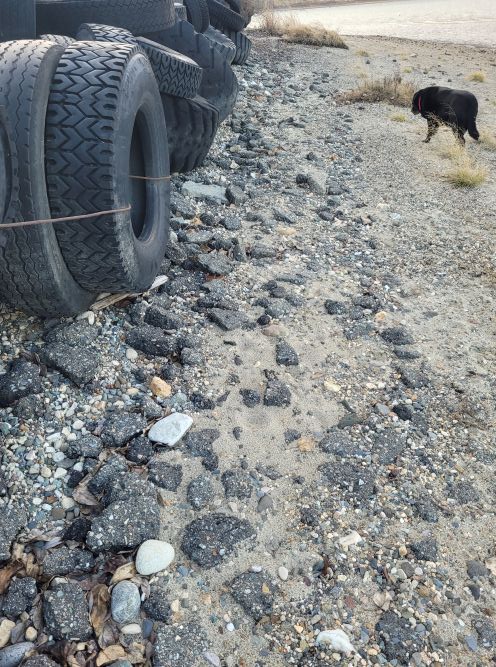
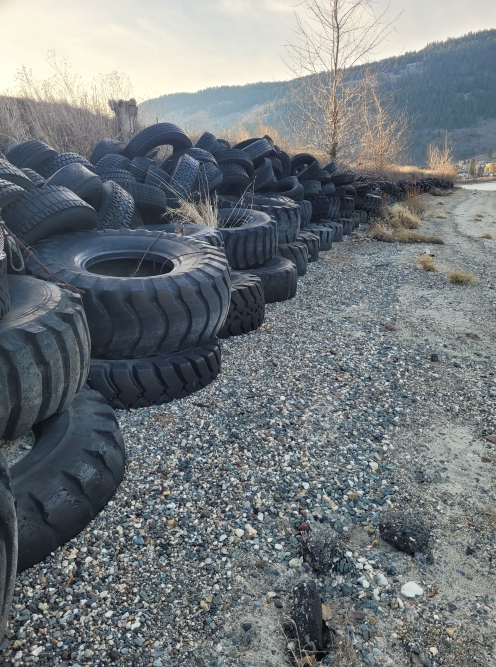
Many decades ago, the owner of the Chase Golf Course, along with the federal DFO and local governments, cooperated in the construction of a retaining wall that was built along the shoreline of Little Shuswap Lake in order to protect the golf course from seasonal flooding. Waste materials were used, consisting of an estimated 4000 old rubber tires of assorted sizes, steel cables and broken chunks of asphalt and concrete. It seemed to solve a lot of problems at the time.
Back then, salmon populations were fairly strong and no one really recognized the full danger posed to aquatic life by the chemicals leaching from the tires and rubble. But now in 2026, we are learning their toxic legacy, and we watch as salmon populations decline both locally and in other areas
Since its construction, many Chase residents have voiced their concerns about the tire berm. But the problem persists and is worsening as the berm disintegrates under the pummeling effects of weather and waves.
The golf course was reconfigured around 2003 and the 7 acre diked parcel of land at 950 Hysop Road was sold to a private consortium of land speculators. On more than one occasion, they tried to have the land rezoned from its C5 (Parks, Recreation and Open Space) designation. The Village of Chase repeatedly denied rezoning and so the land has remained undeveloped.
Now, years later, the toxic, decaying tire berm continues to collapse and pollute important salmon and trout bearing waters. Asphalt that was used to anchor the tires in place, litter the shoreline.
The Chase Environmental Action Society has been working towards understanding the implications and impacts that this berm presents to the health of the ecosystem of our beautiful lake. Our ultimate goal is to clean up this environmental blight with the assistance and cooperation of individual citizens, organizations, and governments.
Scientists have been working for decades to discover why many spawning coho salmon were dying in West Coast streams. Research led them to understand that among the 400 chemicals and compounds that make up a tire, one named 6PPD, when exposed to ground level ozone or sunlight, can transform into multiple other chemicals.
The chemical of most concern is 6PPD Quinone or 6PPDQ. This compound is acutely toxic to some species of fish including coho salmon and rainbow trout. Consternation is rising as two billion tires are sold around the world annually; the micro-plastics eroding from them are found everywhere, including in humans.
Last September, several members of CEAS attended a 6PPDQ on-line workshop hoping to better understand this issue and find out if the tire berm could be leaching 6PPDQ into our environment. One of the presenters at the workshop, Dr Erik Krogh, P Chem (https://web.viu.ca/krogh/) with the faculty of Science and Technology at Vancouver Island University, offered to test water samples for us.
In early December, four water samples were taken from separate sites along the berm, packed on ice and couriered to the lab in Nanaimo. The results came quickly. All four samples had detectable concentrations of 6PPDQ; three samples had concentrations above the BC Water Quality Guideline (WQG) for this compound.
Sample 1) 30.2 ng/L (nanograms/litre)
Sample 2) 31.8 ng/L
Sample 3) 30.6 ng/L
The BC WQG for 6PPdQ= 10ng/L
LC50 (lethal concentration) for coho= 41-90 ng/L
6PPDQ is extremely toxic, even at very low concentrations; it has been leaching from this pile of tires for decades and will continue to do so until the berm is removed. We plan to do further testing that may shed light on other metals and chemicals present at the site. We will keep everyone posted as we move forward.
Restoring this portion of Little Shuswap Lake’s shoreline to a natural state would benefit us all. And be one small step in assisting salmon as they return home through the Neskonlith, Adams Lake and Little Shuswap territories to spawn each year.
 Kelowna / West Kelowna Events